Engineering case study · Synthetic demonstration
Building a trustworthy personal-finance data pipeline
Entirely synthetic demonstration
Budget V2 is a private, locally operated PostgreSQL ledger. This case study uses fictional accounts, descriptions, dates and amounts to demonstrate its engineering without exposing personal financial data.
Financial files are evidence, not a database
Overlapping exports, refunds, repayments and transfers can all distort a naïve spending total. Incomplete history also means a calculated account flow must not be presented as an authoritative balance.
Correctness before convenience
The system keeps exact integer money values, preserves provider evidence, separates technical transaction types from economic meaning and leaves uncertain cases open for explicit review.
- Provider files
- Immutable raw evidence
- Canonical PostgreSQL ledger
- Rules and manual review
- Workbook and aggregate insights
- Integer minor units
- Stable source identities
- Explicit classification precedence
- Unique reciprocal transfer matching
Workflow 01
Preserve evidence before interpreting it
Provider exports are retained as immutable raw evidence. Stable transaction identities let overlapping files converge without turning a repeated import into a duplicate financial event.

Workflow 02
Automate only what can be decided safely
Manual decisions outrank deterministic rules, which outrank provider categories. Ambiguous transactions remain visible for review instead of being silently forced into a spending category.

Workflow 03
Reconcile transfers without guessing
Both account legs remain real transactions. Automatic matching requires equal-and-opposite amounts, different accounts, a narrow date window and a unique reciprocal candidate; ties remain unmatched.

Workflow 04
Generate interfaces from the ledger
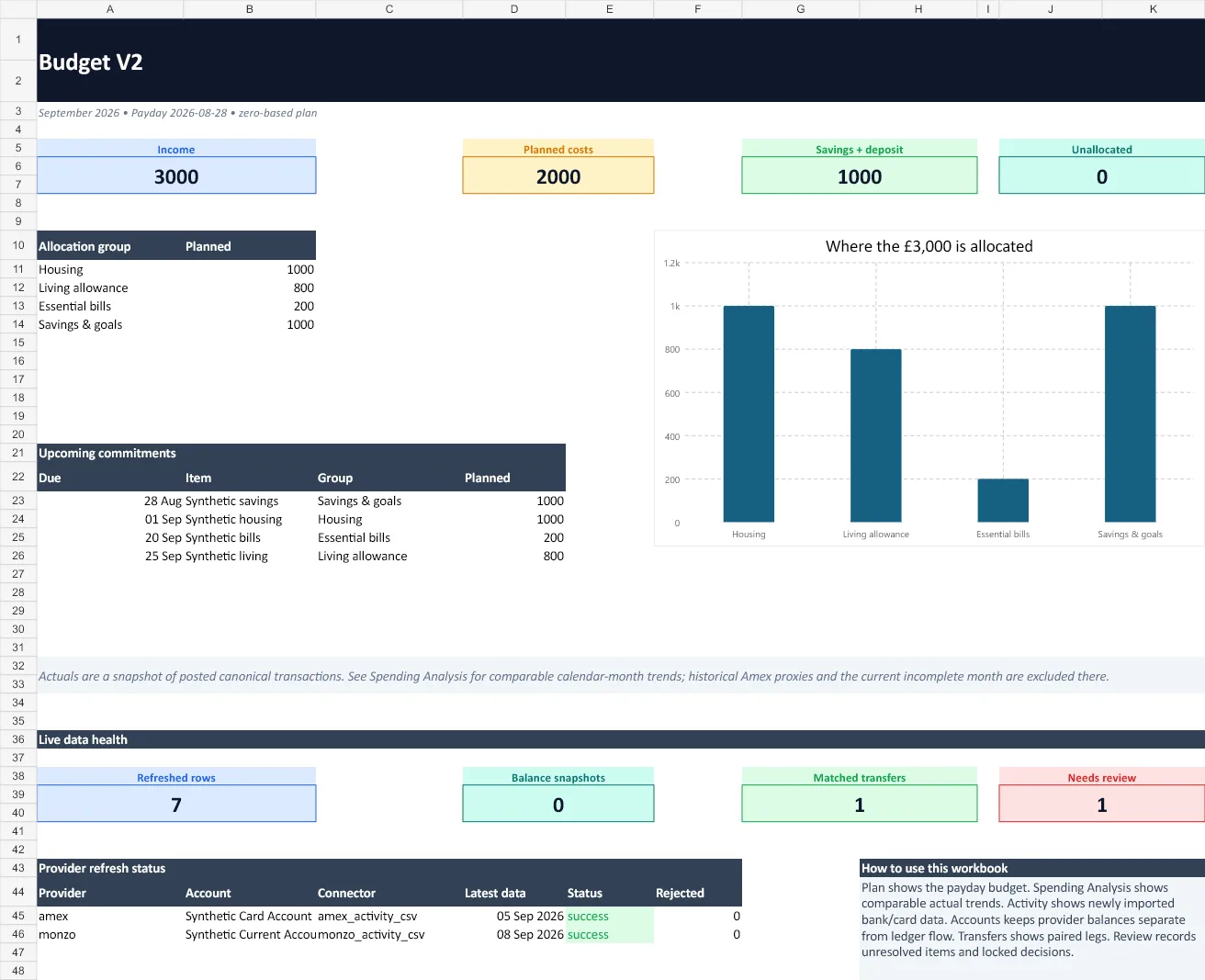
The workbook is a generated read-only consumer of PostgreSQL data, not a second database. Operational checks travel with the export so visible results retain their reconciliation context.
What this does not claim
The public evidence is synthetic. Provider updates are file-based. Historical gaps are preserved rather than filled with invented balances or transfer pairs. Open Banking, authentication and a browser dashboard are outside this pilot.
What the architecture makes possible
Auditability comes from boundaries: raw evidence is immutable, interpretation is versioned, uncertainty remains visible and every interface is generated from the same canonical model.
Downstream outputs
The same canonical data supports comparable monthly analytics and review-gated email drafts. They are secondary consumers of deterministic facts, not alternate sources of financial truth.