

Product engineering case study · Evidence-led public service
Building—and responsibly closing—a UK period-product finder
Shipped product · Measured launch · Archived after limited adoption
Period Place helped people find free period products while making the quality and limits of its evidence clear. I built the service, launched it, tested its distribution and used the resulting data to decide when further investment was no longer justified.
Open interactive demo View public source
The demo uses fictional venues and sample evidence. The original public service remains retired.
Finding products should not require perfect information
Public provision is distributed across councils, charities and individual venues. Stock can change faster than official lists, so a useful finder has to distinguish confirmed coverage from recent community knowledge.
Evidence was part of the interface
Period Place exposed source strength and gaps instead of turning incomplete data into false certainty. Visitors could report a change, but contributions remained moderated before affecting the public record.
System / From source to useful guidance
- Official and partner sources
- Evidence-aware location records
- Map and postcode search
- Moderated community reports
- Visible coverage gaps
- Show uncertainty instead of guessing
- Keep community reports moderated
- Preserve an audit history
- Measure adoption before expanding scope
Product glimpse
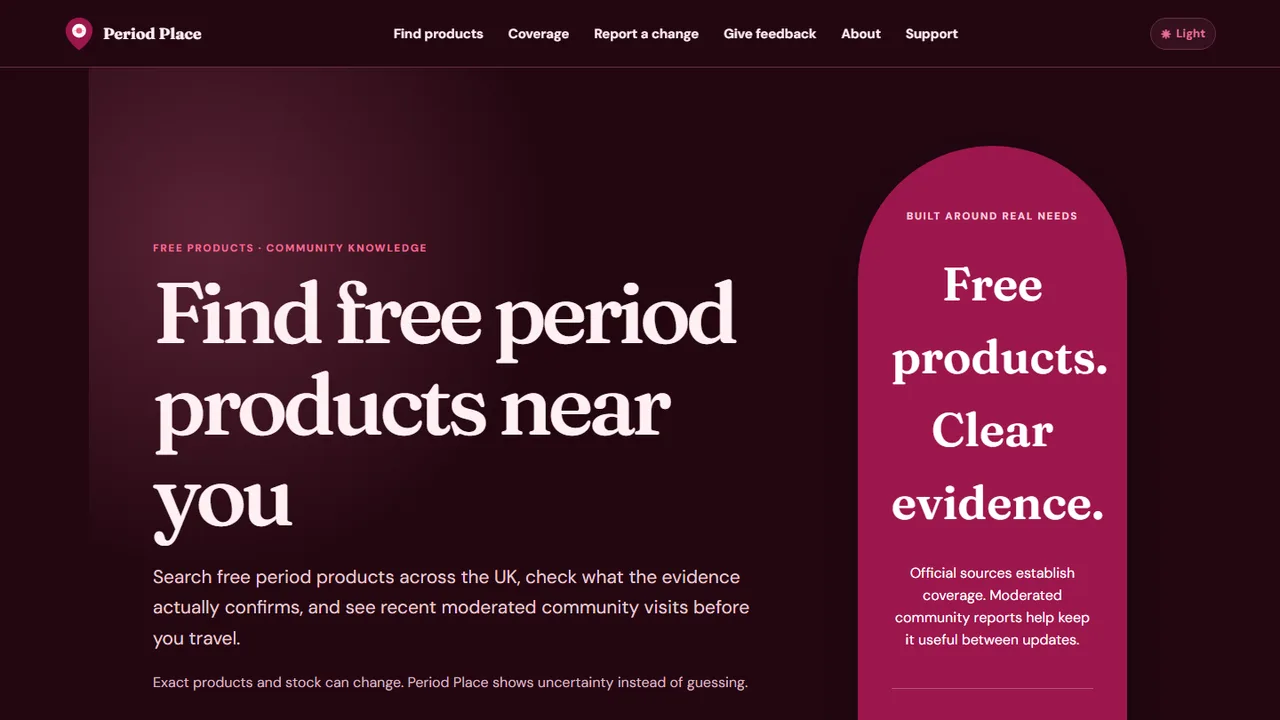
A clear route from need to evidence
The Next.js and TypeScript service combined MapLibre search with a Turso/libSQL data model, authenticated moderation and guarded operational workflows. The interface led with the immediate task while explaining what the underlying evidence could—and could not—confirm.
The launch produced measurable use, not sustained adoption
Across the measured 28-day launch window, the service recorded 48 visitors and 89 pageviews. The finder received 22 visitors and 28 views; location-detail pages received 6 visitors and 10 views.
Discovery remained weak
Google Search Console recorded 6 impressions and no clicks. Outreach produced useful data-source conversations, but no verified durable referral placement. One unverified feedback submission asked how the information was gathered; it did not establish repeat use.
What the numbers do not prove
The service was reliable, but organic reach was incomplete: only 4 pages were indexed, 8 were unindexed, and the sitemap omitted location-detail pages. The launch therefore did not prove that the underlying need was absent. It showed that the current product and distribution approach had not earned enough use to justify another development cycle.
Stopping was a product decision
I chose to archive the service rather than add speculative features to weak adoption. The code and launch evidence remain useful, but hosting and operational attention can be reclaimed while this static case study preserves the work for review.
What I would carry forward
Validate a durable distribution route earlier, treat indexing as a launch dependency and set an adoption threshold before expanding a public-service product. Technical reliability is necessary, but it is not evidence of product traction.